Research behind the lectures

Make the evidence
available.

The teaching is on this site. These notes show where its factual claims come from and how each source is used.

Read the full curriculum ↗
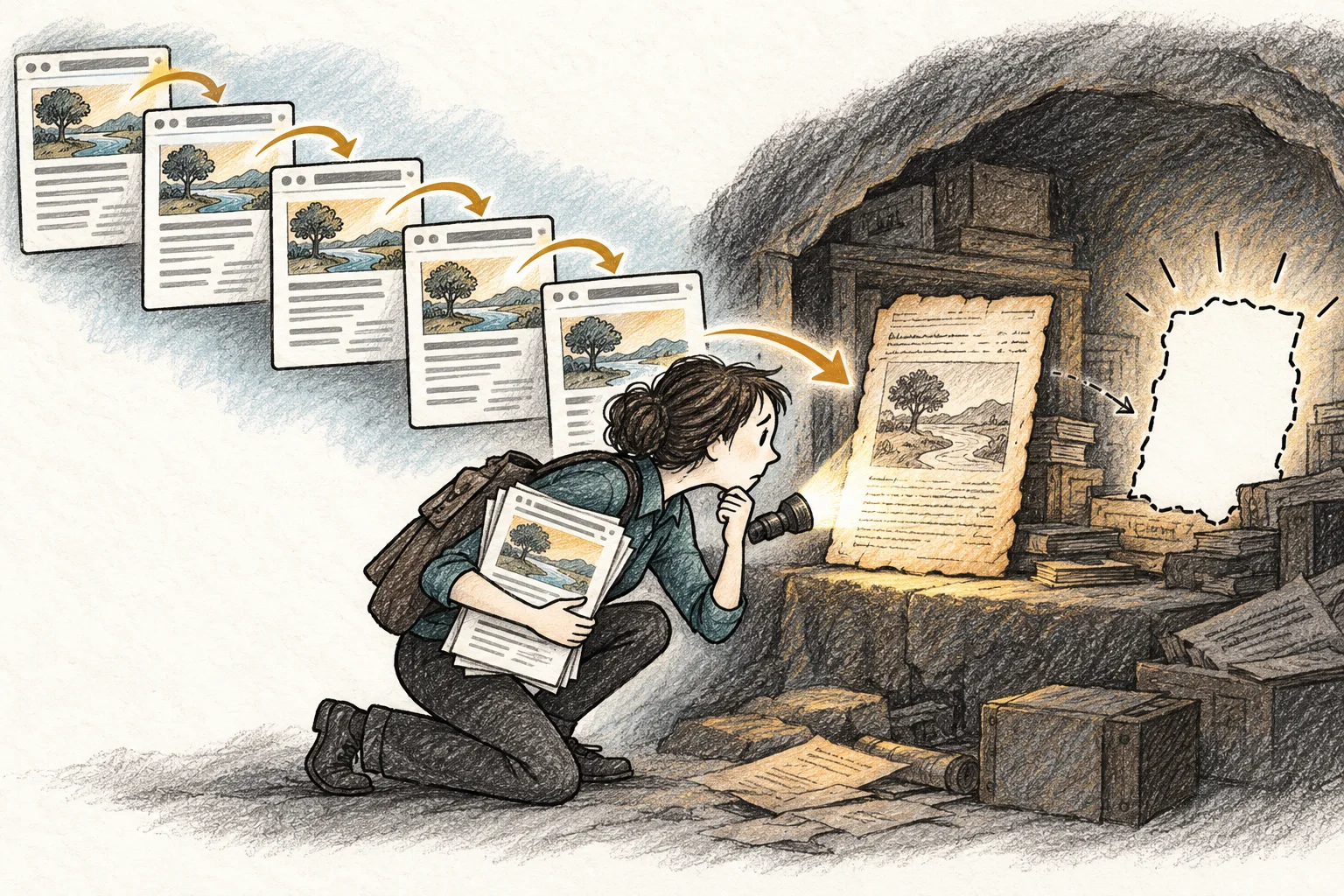
A researcher traces a repeated claim back to its original source
Follow the claim to the source and see what the source actually supports.

The argument and its foundations

Room for Why argues that religion can create emotional dependence, protect certainty from correction, and restrict authorship of a life. The lectures develop that position through examples and reasoning. Empirical claims carry source references at the point where they are used.

The heroin comparison is a functional metaphor developed in lecture 1. The position on autonomy is an ethical commitment. Research on reward, reasoning, childhood learning, and emotion supplies findings with a defined scope. Keeping those roles visible lets readers inspect the argument without making a source say more than it does.

Hypothetical scenarios are identified as teaching examples. The project’s workshop, rubric, and field plan are proposals awaiting their own evaluation. A useful correction identifies the statement, supplies the original evidence, and explains what should change.
16 research notes
01
Experimental study

Emotion regulation

The experiment compared reappraisal, suppression, and a control condition. It found different effects on emotional experience, expression, and physiology. Lecture 4 uses this distinction to explain why reconsidering an interpretation differs from hiding a reaction. Application depends on the situation; the brief attention exercise here is a separate practice.

Inspect the source ↗
02
Government research overview

Attention and mindfulness

NCCIH summarizes findings across varied practices and conditions. Some programs show benefits, while study quality, mixed results, and adverse experiences affect interpretation. Lecture 4 offers a short optional attention exercise, with permission to stop and without a treatment claim.

Inspect the source ↗
03
Research review

Confidence and metacognition

Fleming reviews how people judge their own thinking and how confidence can diverge from performance. The curriculum uses this distinction to ask whether confidence is supported by evidence and to separate workshop enthusiasm from demonstrated learning.

Inspect the source ↗
04
Research review

Motivated reasoning

Kunda describes how motivation can influence the information and reasoning used to reach a desired conclusion. The lectures apply this framework to selective scrutiny and protected beliefs, concentrating on evidence standards that can be observed in an argument.

Inspect the source ↗
05
Education study

Learning to investigate a source

In an online college course, students improved on source-evaluation tasks after instruction that included lateral reading. This informs the source-checking exercises. The study examined that course and its assessments; our field program will need its own evaluation.

Inspect the source ↗
06
Meta-analysis

Teaching critical thinking

This meta-analysis examined instructional approaches to critical thinking, including dialogue, practical problems, and mentoring. It supports deliberate teaching and practice while leaving implementation and assessment dependent on the particular learning setting.

Inspect the source ↗
07
Government educational resource

Reading a scientific paper

This educational guide explains how to examine a study’s question, methods, and results. The curriculum applies those distinctions when checking what was measured, who was studied, and how far a conclusion can travel.

Inspect the source ↗
08
Terminology reference

Cognitive dissonance

The APA definition describes inconsistency among cognitions and the motivation to reduce the resulting discomfort. Lecture 2 separates that concept from motivated reasoning and examines how a person resolves a conflict among commitments.

Inspect the source ↗
09
Philosophical declaration

Our humanist starting point

The declaration sets out values involving dignity, freedom, reason, responsibility, and human welfare. It is a philosophical source for the project’s ethical position. Those commitments are argued openly throughout the curriculum.

Inspect the source ↗
10
fMRI study

Religious experience and reward

Nineteen devout Mormons participated in the analyzed sample. Reported spiritual feelings were associated with activity in reward-related and other brain networks during religious tasks. The dependence framework in lecture 1 is the project’s interpretation of emotional relief, authority, and the costs of doubt; this study supplies a narrower observation about religious experience.

Inspect the source ↗
11
Developmental study

Childhood testimony and judgments of reality

Young children from different religious backgrounds differed in judgments about characters in religious and fantastical stories. Religious exposure was not randomly assigned; family and educational differences remain relevant. Lecture 3 uses the study for the narrower issue of background and testimony shaping judgments, alongside a separately argued position on children’s autonomy.

Inspect the source ↗
12
Field experiments

Sacred values and conflict

In Israeli-Palestinian negotiation scenarios, material incentives could intensify opposition when proposed compromises involved sacred values. Lecture 7 uses this specific result to examine resistance to bargaining and the power of nonnegotiable commitments.

Inspect the source ↗
13
Government investigation

Institutional power and forced assimilation

The investigation documents forced assimilation in the federal Indian boarding school system, including participation by religious institutions. It is a historical case for examining how state and religious authority acted on children, families, and identity. The linked release provides access to the report and its appendices.

Inspect the source ↗
14
Scientific agency explanation

The age of the Earth

USGS explains the evidence for an Earth age of about 4.54 billion years, including isotopic work involving meteorites. Lecture 6 uses the result and the method to show how a claim about the physical world can be examined.

Inspect the source ↗
15
Scientific agency explanation

Radiometric methods and timescales

Different radioactive isotopes provide clocks suited to different timescales and materials. Carbon-14’s half-life is about 5,730 years. Lecture 6 distinguishes radiocarbon dating from the longer-lived systems used for very old rocks and Earth-history questions.

Inspect the source ↗
16
Scientific institution resource

Evidence for human evolution

The Smithsonian explains how fossil, genetic, and other evidence supports human evolution. Lecture 6 introduces converging lines of evidence and asks critics to address the particular observation or method at issue.

Inspect the source ↗
Apply the same standard

What would change
our minds?

A better source, a methodological criticism, a missing alternative explanation, or evidence that a claim was represented unfairly can require a revision. Our field reports should show what was observed and what remains uncertain. The curriculum is meant to be usable and correctable.